If you’ve just received a referral for Mohs surgery, it’s normal to have questions and maybe some anxiety. The word “surgery” carries a lot of weight, and a quick internet search can make things look far more alarming than they actually are for most patients. Dr. Patrick Killian, MD, FAAD, FACMS, a Mohs surgeon at Apex Skin, provides a straightforward walkthrough of what Mohs micrographic surgery is, why it’s recommended, and what you can realistically expect from start to finish.
The Most Common Misconception About Mohs Surgery
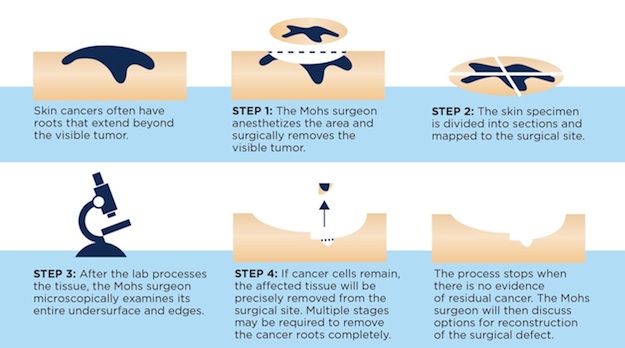
Internet images of Mohs surgery can be alarming: large defects, dramatic results, and the classic “iceberg” graphic suggesting a tiny spot on the surface might extend much deeper. Those cases are real, but they are the exception. They typically represent cancers that went untreated or were inadequately treated for years. When cancer is caught early and treated with Mohs surgery, one or two stages is the norm and the wound is far smaller than most patients fear.
The goal, as Dr. Killian puts it, is that when patients return for follow-up, you can barely find where the work was done. “Can you even find where you did the work?” is a question that comes up nearly every day, and that’s the goal.
What Is Mohs Surgery and Why Is It Recommended?
Mohs micrographic surgery is considered the gold standard for treating basal cell carcinoma and squamous cell carcinoma, the two most common types of skin cancer. What sets it apart from a standard excision comes down to precision and real-time results.
With traditional surgery, a tumor is removed and sent to a pathologist, and you typically wait days, sometimes more than a week, to find out whether the margins were clear. If they weren’t, you often have to go back and remove more tissue without knowing exactly where the cancer remained.
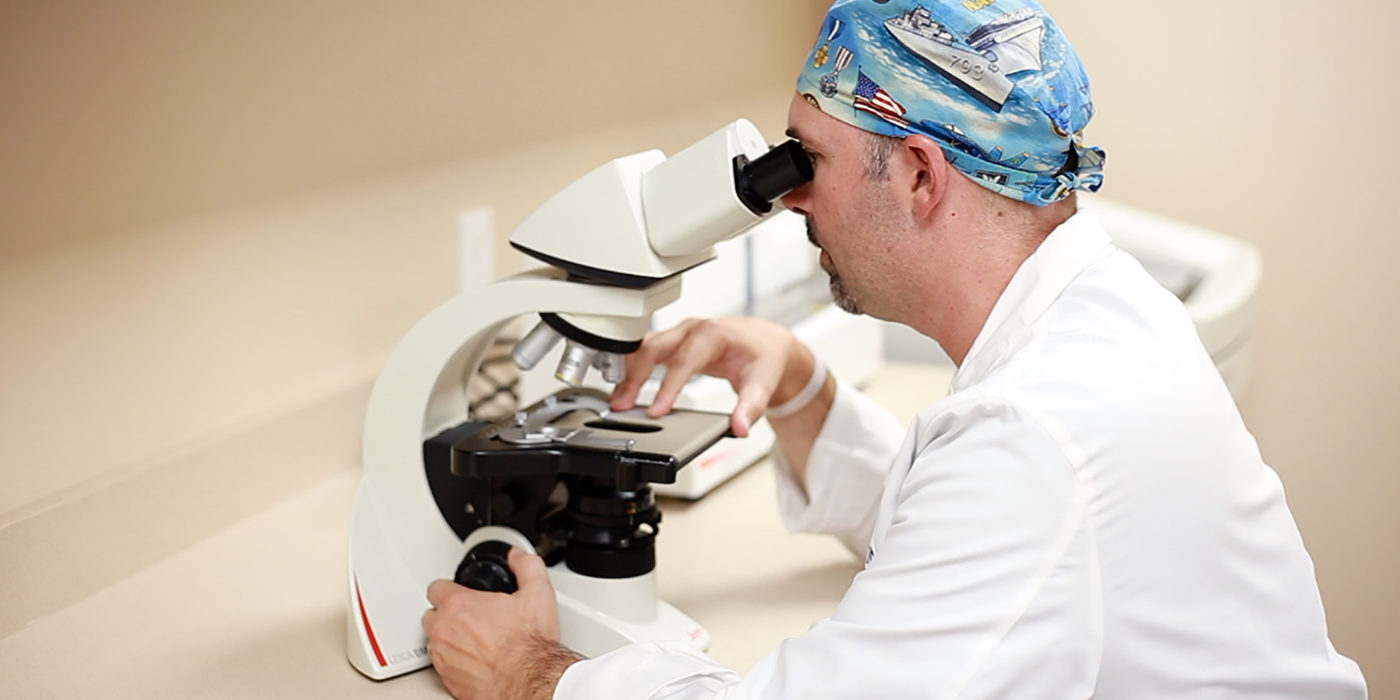
Mohs surgery changes that entirely. The tissue is processed and examined under a microscope right there in the office, usually within 30 minutes. Dyes are applied to color-code each edge of the tissue, allowing the surgeon to map precisely where, if anywhere, cancer cells remain. If more tissue needs to be removed, only that specific area is targeted. The result is the highest cure rate with the smallest possible impact on surrounding healthy tissue.
Who Is a Candidate?
Not every basal cell or squamous cell carcinoma is automatically treated with Mohs surgery, as insurance criteria play a significant role. Generally speaking, any skin cancer on the head or neck qualifies regardless of size or whether it’s a first occurrence or a recurrence. Cancers on the hands and lower legs also typically qualify, since there’s limited skin laxity in those areas.
For cancers on the trunk or extremities, the tumor usually needs to be at least two centimeters—roughly the size of a nickel—or be a recurrence in the same location. Certain aggressive subtypes also qualify regardless of location, including infiltrative basal cell carcinomas and poorly or moderately differentiated squamous cell carcinomas.
Before a Mohs Procedure
One of the things that surprises patients most is how little preparation is required. Because Mohs surgery is performed under local anesthesia, you are not put to sleep. You can eat a full meal beforehand and go about your typical morning routine.
The main things to keep in mind: avoid alcohol for 24 hours prior, as it thins the blood. As for blood thinners, the guidance has evolved significantly over the years. A large study examining roughly 20,000 to 25,000 Mohs patients found that those who stopped their blood thinners prior to surgery had a 2 to 3% rate of major clotting events, including strokes, heart attacks, and pulmonary embolisms.
As a result, most patients are now advised to continue their prescription blood thinners as usual. The one exception is patients taking low-dose aspirin purely for prevention with no history of heart disease or stroke, who may be asked to stop it five to seven days before the procedure. If you’re on a prescription blood thinner or have been directed by your doctor to take daily aspirin, do not adjust it without specific guidance from your Mohs surgeon.
When patients feel anxious, a helpful comparison is thinking of Mohs surgery less like major surgery and more like a cavity filling at the dentist.
“When patients hear ‘surgery,’ they think, ‘I’m going to be unable to do what I want to do for weeks or months,'” Dr. Killian explains. “And that’s not the case.” Most patients are back to their usual activities within a couple of days.
During the Procedure
Step by Step
By the time a patient arrives, they’ve already had a biopsy confirming the diagnosis. Dr. Killian examines the area under bright light, marks it, and walks through exactly what will happen, including wound care after they leave. That conversation takes about 10 minutes. A medical assistant then numbs the area and gets the patient positioned.
The numbing itself involves a brief prick followed by stinging or burning for about 10 to 20 seconds. Once the local anesthetic takes effect, it typically stays effective for a couple of hours, well beyond the time needed for the procedure. The removal itself takes anywhere from one to five minutes.
After the tissue is taken, the assistant holds pressure on the site while Dr. Killian processes it in the lab. Any bleeding is addressed with cauterization, and a temporary dressing is applied. Patients wait in the room, usually about 30 minutes, while he examines the tissue under the microscope.
What’s Happening in the Lab
During that waiting period, dyes are applied to the tissue so each edge is color-coded.
“We can kind of map things out and know precisely if there is an area that’s still positive,” Dr. Killian explains. “We can go back to just that positive area and not necessarily take a lot of normal tissue out unnecessarily.”
If the margins are clear, the conversation turns to closure. If not, another stage begins with another 30-minute wait.
How Many Stages?
About 80 to 90% of patients clear in one or two stages. Primary tumors that haven’t been previously treated tend to clear quickly. Recurrent tumors that have been scraped, burned, or frozen multiple times can sometimes require three, four, or even five stages, because the surface has repeatedly been treated while the deeper portion continues to grow.
After the Cancer Is Removed
Closure and Reconstruction
Once the cancer is fully removed, the next step is deciding how to close the wound. In areas where the skin can be pinched together, the wound is typically sutured, since stitched wounds heal faster than those left open. In areas with limited skin laxity, such as the ears, nose, scalp, and lower legs, options include skin flaps using adjacent tissue or skin grafts.
That said, many wounds, including some fairly large ones, heal remarkably well on their own when properly cared for. Referrals to plastic surgery for reconstruction are needed only in rare cases.
Wound Care at Home
Wound care instructions are specific and worth following closely.
For sutured wounds, skip the antibiotic ointment. Without an open wound entry point, it sits on the surface and does nothing, and can actually sensitize your skin to the antibiotic unnecessarily. Instead, apply Aquaphor, Vaseline, or petroleum jelly and cover with a bandage. Leave the first bandage on for about 24 hours, then wet it before removing so it pulls off more gently. After that, patients can shower, pat dry, reapply ointment, and rebandage daily.
One common myth worth addressing: letting a wound “air out” does not speed healing. Wounds don’t draw oxygen from the air that comes from the bloodstream. Moist wounds heal faster than dry ones.
For wounds healing naturally without stitches, a prescription antibiotic ointment is typically recommended since it can work directly into the open wound to help prevent infection. Continue covering the wound with ointment until the surface is level and flush. Once it looks more like a healed burn than an open wound, that’s when it’s appropriate to let it dry out.
Healing Timeline and Follow-Up
Most wounds on the head and neck heal within one to three weeks, even in older patients, thanks to strong blood supply in that area. Lower leg wounds are a different story and can take months, due to reduced arterial supply and venous drainage. Compression with a stretchy wrap is strongly recommended for lower leg wounds to minimize swelling and support healing.
Patients with sutures typically return in one to two weeks depending on location. Facial sutures often come out in about a week, while sutures on the back or shoulders may stay in up to two weeks. Patients healing by second intention are given the option to return in two to three weeks for a wound check. Most first-time patients will be seen back within about two weeks to either have stitches removed or to assess how the wound is progressing.
Warning Signs to Watch For
Some pinkness or redness around a sutured wound is normal, as the body reacts to sutures as foreign material. The more important warning signs are:
- Pain that gets worse instead of better. Discomfort on day one is expected and should improve daily. Pain that increases after several days of feeling fine is a red flag for infection. “If you’ve been doing great for four or five days and all of a sudden things are really hurting, that’s a big red flag,” Dr. Killian says.
- Yellow or cloudy drainage. A widely known sign of infection that should be evaluated promptly.
- Bleeding. For most patients, the first 24 hours carry the highest bleeding risk. For those on blood thinners, that window extends to 48 to 72 hours. If bleeding occurs, apply gentle but constant pressure for 5 to 10 minutes, not repeated dabbing. “It doesn’t need to be a lot of really firm pressure, but it needs to be constant,” Dr. Killian explains. That approach stops bleeding in the vast majority of cases.
Addressing Scarring After Mohs Surgery
Scars evolve significantly over time. At one week, one month, three months, and beyond, scar tissue looks different at each stage. By about one year, a scar has essentially reached its final state without intervention, which is why most aren’t addressed for at least a month, sometimes several.
Options for scar treatment include removing redundant tissue for minor irregularities, dermabrasion to soften edges and improve contour, laser treatments, and silicone scar gels. Silicone gels are frequently recommended because they help the scar mature faster, speeding up the natural process of softening and fading. For fair-skinned patients, whose scars tend to stay pink longer, silicone gels can cut that timeline from two or three months down to closer to one.
The aesthetic team at Apex Skin can evaluate scarring after Mohs surgery and recommend the right treatment based on the location, age, and nature of the scar.
Moving Forward
Mohs surgery is one of the most effective tools in skin cancer treatment, and for most patients, the experience is far less intimidating than the name suggests. With the right preparation, realistic expectations, and proper wound care at home, the majority of patients move through the process smoothly and are back to their typical lives quickly. If you have questions at any point—before, during, or after your procedure—the team at Apex Skin is here to help.
Dr. Patrick Killian was raised in Akron, Ohio, and graduated from Western Reserve Academy in Hudson, Ohio. He then went on to the University of Notre Dame in South Bend, Indiana where he completed his pre-medical studies. He was inducted into the Phi Beta Kappa Honor Society and graduated Summa Cum Laude finishing as the salutatorian of the College of Science. He then returned to Ohio and spent the next 8 years in Columbus, attending the Ohio State University School of Medicine from 1995-1999. From there, he completed his Transitional Internship year at Riverside Methodist Hospital before returning to Ohio State for his dermatology residency from 2000-2003.