
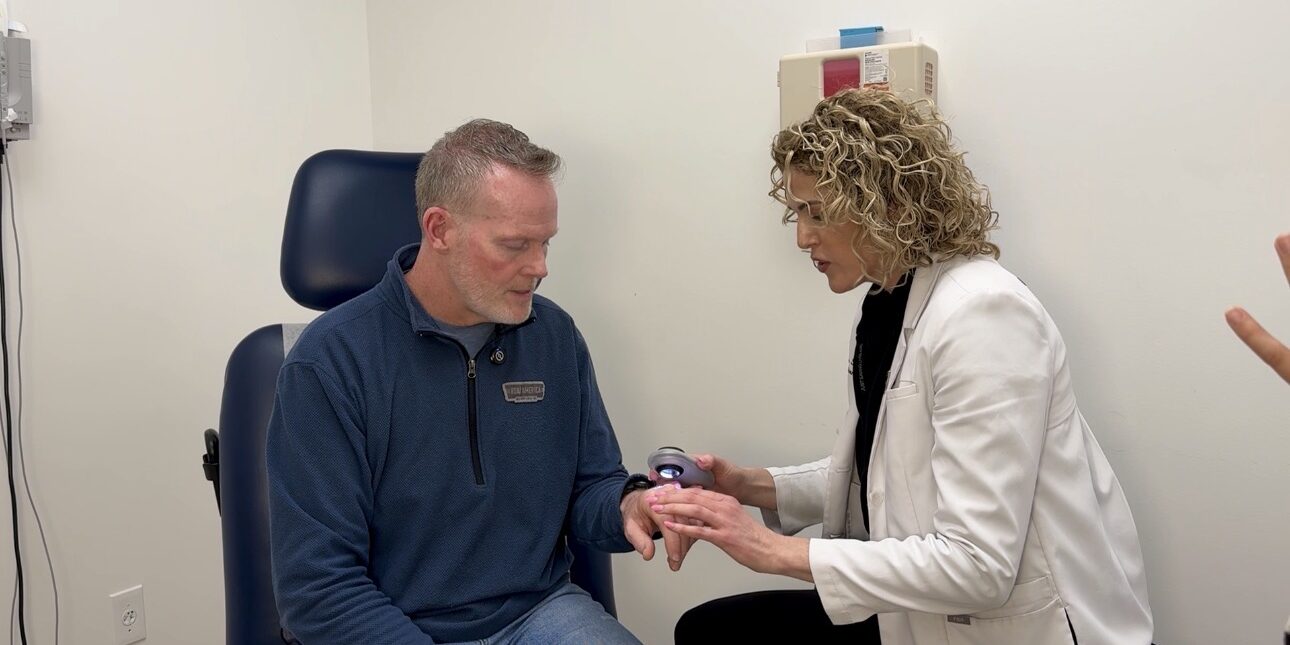
Mark Nolan grew up the way a lot of people did: outdoors, in the sun, without much of a second thought about it.
With red hair, freckles and fair skin that was prone to burning and summers spent as a lifeguard, slathered in whatever Coppertone SPF was available, his mom was diligent about sun protection. But he didn’t always carry the same concern as a teen. Plus, in the 70s the cultural script and education around sun exposure was still encouraging a base burn, according to Mark. That advice didn’t work for Mark.
“My skin never browned,” Mark recalls. “I was just varying shades of pink whenever I got out into the sun.”
This is a story that tends to sound familiar to a lot of people, which is why Mark is passionate about telling it.
If your history is similar to Mark’s, schedule a full body skin cancer screening today.
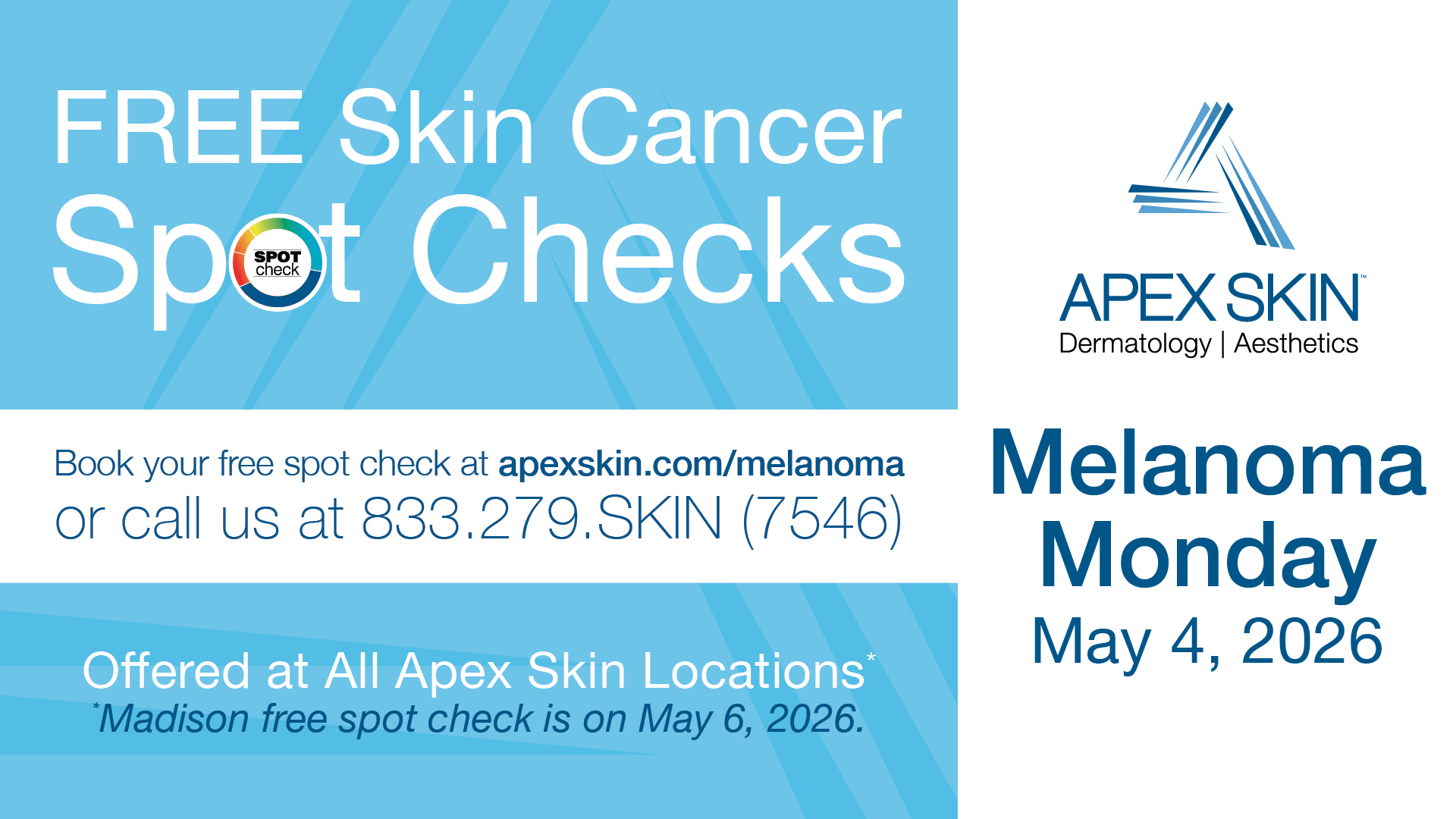
When Sun Damage Starts Showing Up
Mark didn’t think much about his sun exposure until his early 30s when a combination of things nudged him toward his first dermatology appointment. He’d been working in TV news and had covered enough stories about melanoma to start paying attention to his own skin. Then, after a neighbor had mentioned they got regular skin checks he thought to himself ‘a skin check can only help.’
What he found at that first appointment was a wake-up call: precancerous lesions called actinic keratoses were discovered in multiple spots. The plan of action was to treat what was there, and come back in six months when there would likely be more, the dermatologist cautioned.
Megan Sevilla, PA-C, sees patients like Mark regularly. People who spent their early years outdoors, often in high-exposure situations, and are now reckoning with what that means for their skin.
“A lot of the damage is done from age zero to age twenty,” she explains. “So, even if patients have good sun protection habits now, we are kind of playing catch up. But that doesn’t mean it’s ever too late to start protecting your skin from the sun.”
How to Detect Skin Cancer Early
After that first visit, Mark made it a point to get a skin check every six months. During those appointments, he and his care team are regularly treating, monitoring and managing actinic keratoses. This level of consistency and high quality care has continuously kept him safe.
It all starts with a first visit, and often patients coming in for their first full body skin exam are surprised at how straightforward it is.
“Most people are surprised that it only takes five to ten minutes,” Sevilla says. “It’s very comfortable and it allows us to address any concerns and make sure there is nothing to worry about.”
When something does need a closer look, she walks patients through the process clearly. A biopsy, which involves numbing the area first so the procedure is painless, allows her team to send a specimen directly to Apex’s in-house pathology lab at the Mayfield Heights location.
“As soon as we get the results, we call the patient,” she says. “If something extra needs to be done, we’re able to treat it right here in our office.”
For patients who feel nervous, embarrassed, or like they should have come in sooner, she has a consistent message: “It takes a lot of courage for you to come in, and I’m really proud of you.”
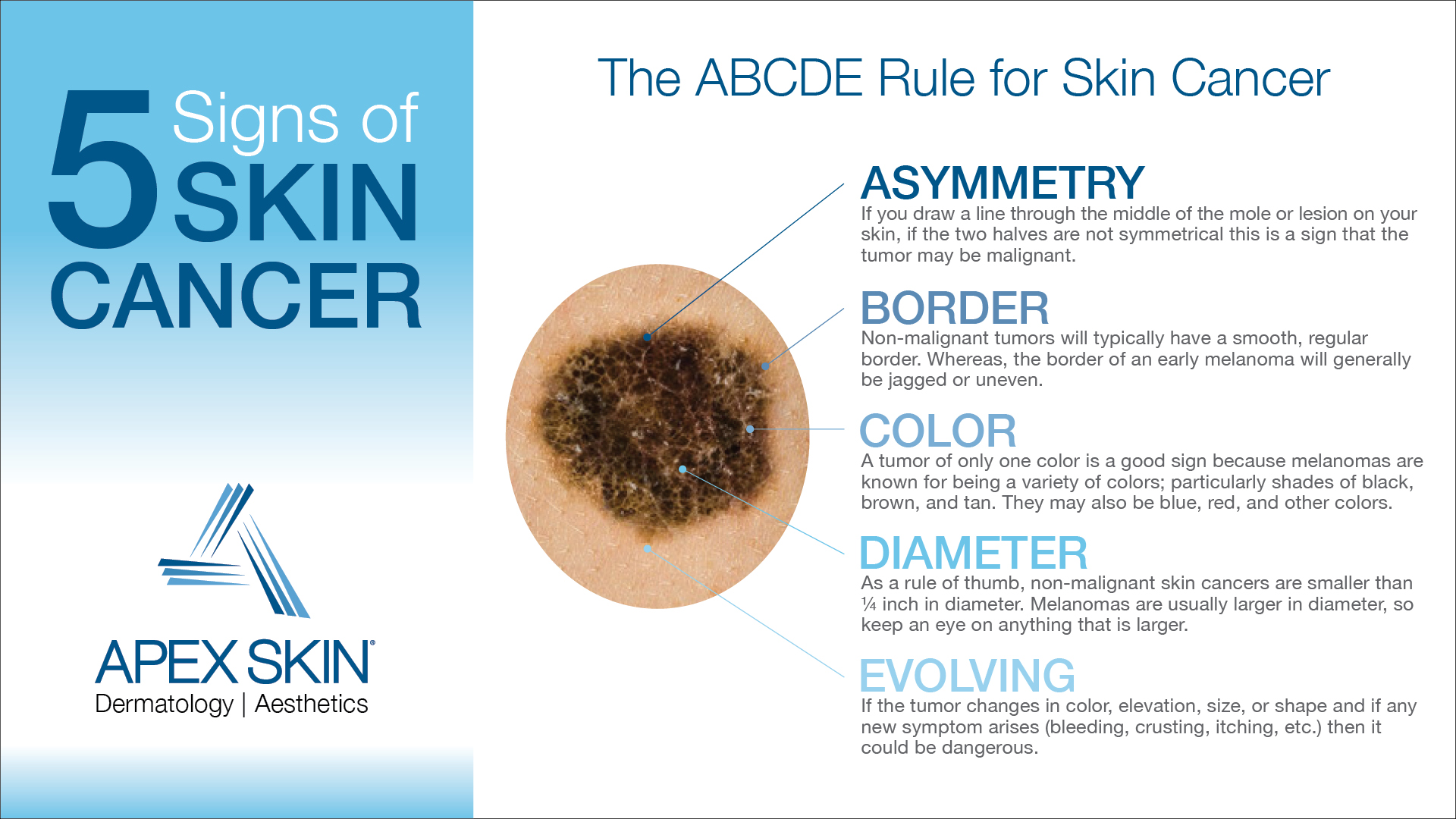
Mohs Surgery: What It Is and What It’s Actually Like
Mark has been through Mohs Micrographic Surgery more than once after learning some of his marks were non-melanoma skin cancer. And while the word “surgery” carries a certain weight, he’s discovered that the Apex operating room with Dr. Garcia is calm and has a sense of genuine care.
“It’s much less invasive than you would think,” Mark shares. “When you’ve got someone like Dr. Garcia doing the work, you’re in great hands and you don’t feel a thing.”
This precise procedure used to treat skin cancer focuses on removing small layers of skin that are studied under a microscope while the procedure is happening. The Mohs surgeon removes skin layer by layer, then acts as his own pathologist examining each layer under a microscope to confirm whether the margins are clear. If they are, the procedure is done. If not, only the specific area where cancer remains is addressed in the next layer.
“The least amount of skin possible is taken in order to preserve as much of that healthy tissue as possible,” Sevilla says. “It’s a very precise technique.”
What stayed with Mark most wasn’t just the outcome, it was the experience of being walked through every step of it in real time by Dr. Garcia himself.
“He’ll take you from start to finish, out loud, verbally explaining everything that’s going on throughout the process,” Mark says. “There’s nothing more comforting than that. You’re in good hands whenever you’re here with Apex.”
Building a Routine That Actually Sticks
After years of skin checks, biopsies, and Mohs procedures, Mark has built a relationship with sun protection that looks nothing like the Coppertone-and-a-floppy-hat approach of his lifeguard days. Sunscreen can be found everywhere in his house. He doesn’t mow the lawn without a wide-brimmed hat and when it’s really hot, he even wears gloves.
“As good as sunscreen is,” he says, “an actual barrier always helps.”
Sevilla’s advice for patients who are just starting to build that kind of routine is simple: find a sunscreen you’ll actually use.
“I don’t care if it’s chemical or mineral, a stick or a spray, as long as it’s SPF 30 or higher, the best sunscreen is the one you’re going to put on,” she says. She sends patients home with samples so they can find what works for them before committing to anything. “They’re accessible at any drugstore. There’s no barrier to starting.”
She’s also direct about where patients most commonly fall short: inconsistency. Sunscreen applied on beach days but skipped during a walk, a bike ride, or an afternoon of yard work adds up over time in the same way Mark’s lifeguard summers did. The goal isn’t perfection. It’s building habits that reduce the cumulative load.
Why Now is the Time for Your First Skin Check
Mark has been sharing his story in partnership with Apex for years in hopes that people who look like him and have had sun exposure like he did will hear him.
“I don’t care if you’re 12 or 90. It doesn’t matter. There’s nobody at Apex that hasn’t seen whatever you have going on,” he shares. “There’s no embarrassment, there’s no shame. Apex Skin is here for you.”
Through radio commercials, TV spots, and most visibly, as the emcee of Miles for Melanoma, the annual 5K event that Apex Skin presents each year, Mark’s story has resonated with thousands of people.
“Inevitably, every year, one, two, three people will come up to me and say they’ve heard me talk about Apex and that’s why they’re at the tent, getting a check,” he says. “That makes me feel good. It makes me happy that some people made that decision because they heard my voice or saw my face.”
Simply put, there is never a bad time to start taking care of your skin. No matter the age, condition or years of damage, the Apex team is here to help.
“I had a patient come in today for their first skin check,” Sevilla shares. “They were 75. It is never too late. Most of what we find in dermatology is highly treatable when caught early. Come in, let us take a look and then we’ll talk about what comes next.”
Ready to schedule your full body skin exam? Apex Skin’s board-certified providers are here for patients at every stage whether it’s your first check or your thirtieth. With 15 locations in Northern Ohio from Ashtabula to Lorain and from Canton to Mayfield Heights, getting started has never been easier.